Monday, July 20, 2015

Week 9: Coming down to the wire!

Oh Gosh! We only have one more week! Time flies when you're having fun and working hard!

Week 9 of our field school is traditionally the time where we make sure that we have documented everything correctly and begin to wrap up the excavation through standard procedures of documenting the wall profiles of our units and one last map and photo of the floor of each unit. In that vein, much of week 9 was spent mapping profiles, checking paperwork, and taking many photographs. 

Early in the week, we continued to excavate the unit on private property adjacent to the Simpson Lot, Unit 150. Our goal for the week was to complete two sterile levels before beginning to clean off the walls of the unit for final documentation. By sterile levels, we mean excavating two 10 centimeter thick arbitrary layers containing no cultural material or artifacts. Arbitrary levels help us to maintain vertical control, particularly when we don't know what kind of stratigraphy we will encounter while excavating in an area. We finished excavating these sterile levels early on Thursday.
Here is the last plan view photo of Unit 150. The black material in the southwest corner is the remains of Feature 504 section A that could not be removed because of in situ artifacts in the walls.
Beth began the process of cleaning up our wall profiles for pictures and profile maps on Thursday. The fun thing about cleaning wall profiles is that we often find things we missed by centimeters, if not millimeters. In this manner, we found a kaolin pipe stem fragment and a molded clear glass candlestick fragment from Feature 504 C, a sheet midden type feature. We also found a piece of terracotta ceramic that may be a turpentine pot in the corner of the north and east walls. We were able to complete the photos of the North and East profiles on Friday. 
This is the north wall of Unit 150. The red circle indicates the terracotta ceramic fragment. 
This is the east wall of Unit 150. The white arrows indicate the red-orange clay we found in Feature 504 section E that may be associated with a compost pit. 
Meanwhile on the Simpson Lot this week, the rest of the crew was very busy!

Early in the week, we were excavating levels 3 and 4 in Unit 159 North Half to begin exposing the rest of Feature 472 section B, a brick wall of the basement. Unit 159 was staked in as a 2 meter by 1 meter unit, but we are only excavating the north half currently. The plan was to extend to the full unit if  Feature 472 section B had extended into the southern portion. Based on last Friday's GPR (ground penetrating radar) results, we expect that Feature 472 will turn west, although this feature has done none of the things we've expected it to do. Feature 472 may possibly be the covered stairway into the basement, depicted in a photograph as well as the the Simpson family oral family history. More on this next week!
Unit 159 North Half with Feature 472 section B exposed mid-level 4. 
In Unit 160 East, 1 x 1 meter, we are working slowly but steady to finish excavating what we think may be a pair of brick piers with a curtain structure like that of Units 153 and 155. We are excavating only the east 1 meter by 1 meter portion of Unit 160 because it is feared that should we open the full 1 meter by 1.5 meter unit, the proximity to Units 153 and 155 may cause instability of exposed brick features.
Unit 160 East, 1m x 1m, Level 2 Zones A, B, and C are pictures here. On the Simpson Lot, we are excavating using natural strata so each new soil color will require a new level. In this case, zones were used to indicate different soil conditions but same or similar color types.  

A surprise rainstorm may have chased us off a bit early Friday, but we were still in good spirits! 
Here's Hanah, Robert C., and Beth hustling to bring in our equipment after we were hit with a surprise rainstorm Friday! 

One more week and we are finished for Summer 2015! This coming week is going to be the busiest yet! We have more profiles to document and more brick wall features (Feature 472) to chase! Stay tuned! 

Thursday, July 16, 2015

Arcadia Mill Field School Presents: Robert Love!


Introducing: Robert Love! 


Robert Love is a senior at the University of West Florida where he has majored in archaeology for the last four years. He will be graduating this year. His main archaeological interests are prehistoric occupation sites throughout the Southeastern United States and Robert hopes to one day work in Cultural Resource Management (CRM). Even though he is not interested in historical archaeology, he thinks Arcadia has been a great environment to learn the basics of archaeology and the general principles that will be expected of him on future archaeology projects.

Remember: This Friday, July 17th, Arcadia will be hosting the LAST Field Lab of the summer! If you enjoy history, archaeology or just want to know more about what we are doing,
 please join us!
The Field Lab runs from 10am to 2pm at the Arcadia museum! 
People of all ages are welcome, although children under the age of 16 must be accompanied by a parent or guardian. 

Tuesday, July 14, 2015

Week 8 Update

Week 8 is a crucial point in the field school. We have closed several units meaning we will no longer excavate any portion of the unit. It is this time that we are finalizing our documentation and paperwork for those units as well as opening a few more units as the students become more comfortable, more confident, and more independent during this field school. The end is near, so we are in rally mode to collect as much data as possible! The photograph below depicts two of our students, Robert Love and Ken Newquist, mapping the profiles of Unit 152 after excavation was completed.


We opened up several new units this week to get a bigger picture of the various structural remains belonging to the Simpson House. Unit 158 is a 1 meter x 1.5 meter unit that is adjacent to Units 138, 156, and 157. Unit 158 was set in place to capture more information about the anomalous brick wall that turned to the south in Unit 157 when we initially thought it would turn to the north. Progress on this particular unit was quick because we have an idea of what we are looking for in the unit and could see the stratigraphy of the surrounding units. We excavated to level 4 when we encountered the brick wall and associated brick rubble, as photographed below facing north.


The image below depicts every unit that contains portions of the brick wall, pictured facing south. (Unit 138 is in the top left, Unit 154 is in the bottom left, Unit 156 is pictured center, Unit 157 is in the bottom right, and Unit 158 is in the top right corner of the photograph.)


Unit 159 was also opened this week. It was an extension to the large group of units, adjacent to Unit 158. Unit 159 is a 1m x 2m sized unit, oriented north/south to capture the brick wall. We will be interested to see where exactly that wall goes, but we must hurry before field school is over! Below is a photo of our field school student Hanah Brock working diligently on Unit 159! Stay tuned for an update on what this unit has to offer!


Unit 160 was another new unit opened this week. It measures 1m x 1.5m and is immediately adjacent to Unit 152 (which was one of the first units opened this summer). Unit 160 was opened to investigate the potential for another brick pier and curtain like that of Units 153 and 155. Based on the layout and configuration of the features in those earlier units, we expect another brick pier and curtain to be within the boundaries of Unit 160. Probing efforts did indicate some rubble beneath the surface, but we really have no way of knowing for sure unless we peel back the layers. Below is our graduate student from UCF, Beth Chance, happily removing the sediment with her square shovel in hand!


We also conducted a GPR (ground penetrating radar) survey over a portion of the Simpson Lot with the help from Jennifer Melcher, UWF Archaeology Institute, and her father Mr. Melcher. She helped us survey the private property at the beginning of the field school and returned with some help on Friday to help us explore the areas we may not get a chance to extensively explore this summer. We set a 10m x 20m grid over the southern portion of where we expect the Simpson House to be and the team towed the GPR up and down to get a full picture of what lies beneath. Pictured below is Jennifer, Mr. Melcher, and Beth towing the equipment through the brush to obtain the most accurate data possible.


The GPR survey produced great results! As pictured below, you can see some linear signatures (circled in blue), at just 21-34 cm below the surface, that may coincide with the brick wall feature in our conglomerate of units (Units 138, 154, 156, 157, 158, and 159). We expect to reveal a portion of that in Unit 159 next week. The other small circular signatures are believed to be additional brick piers, similar to those uncovered in Units 152, 153, and 155. Some appear to be in a linear orientation with one another. If time permits, we hope to explore those with shovel tests!

Be sure to look for next week's update on all the progress of the ongoing units! Also this Friday, July 17th, we will be hosting our very last field lab at the Arcadia Museum from 10 am to 2 pm! It is the last one of the summer, so come on by to get your hands dirty with local history by rough sorting artifacts from this summer's field school! Tours are also available on site! We hope to see you then!


Wednesday, July 8, 2015

In the Spotlight this week: Beth Chance


This week we're featuring our student: Beth Chance! 

Beth is currently a graduate student at University of Central Florida where she is researching a water-powered mill located in southern Seminole County, which will be the subject of her master’s thesis.  She is excited to be at UWF this summer studying the Arcadia Industrial Mill Complex and the settlement associated with it. She is look forward to using the knowledge she is gaining in her own research.  In her spare time, she enjoys riding her road bike and spending time fishing and hiking. 


Also this Friday, July 10th, we will be hosting our field lab at the Arcadia museum
 from 10 am to 2 pm! If you enjoy history, please come join us!
Children under the age of 16 need to be accompanied by a parent or guardian. 

Displaying Bio.docx.

Sunday, July 5, 2015

Week 7! Only 3 Weeks Left!

This week was a short week due to the 4th of July but boy, did we make the most of it! With the cooler weather this week and awesome data we collected, this week was a dream come true!

If you'll remember last week, we were working on a refuse pit feature in Unit 150, on the private property adjacent to the Simpson property. We had ended the week with us uncovering a large iron concentration in the south half of Unit 150, which we called Section D of Feature 504. This week we dove right in on Unit 150, removing the majority of the iron concentration on Tuesday after spending Monday documenting the extent of this new feature section. The removal of this feature was a delicate procedure because iron artifacts exist in a state of equilibrium underground but become very fragile once exposed or disturbed.  We documented each recognizable iron artifact before removal because of the real possibility that the artifact would not make it back to the lab for processing and conservation.When the iron artifacts were removed, many unfortunately did crumble into many indeterminate small iron fragments, due to extended exposure to moisture and air. However, due to our diligence, we have photographic documentation and some diagnostic features have been preserved, such as the two decorative handles adorning the pail.

In Unit 150, undergraduate Robert Cornforth and graduate student Supervisor Dani Mount are excavating around the iron pail in order to remove it .

A close-up picture of the iron pail before its removal. Notice the fragile edges that have already begun to crumble. 
This feature section has been rich in diagnostic artifacts, which means they have distinct features or characteristics that can help us date when these depositional episodes occurred and who could have possibly placed them there. Besides the many iron cans of various sizes and shapes, there were many bottles, of both clear and amber glass. One of the exciting finds was a clear early molded glass bottle with a complete maker's mark on the base, which we confirmed as belonging to a company that only manufactured these types of bottles with that maker's mark between the years of 1875 and 1878!


The first bottle of many, from Feature 504 Section D with a complete maker's mark.
By Wednesday, we had removed Feature 504 section D and now had the fullest extent of Feature 504 section A! This dark brown feature was characterized by large burned oyster shells and large quantities of carbonized wood when it was first uncovered in the north wall of Unit 150. While these were still present in the feature fill, large quantities of mostly complete glass bottles appeared. Many of these bottles were of the early molded variety, missing the sucker scar of modern machine-made glass bottles but did not have any of the characteristics of hand-blown or free-blown bottles, such as puddling at the base and pontil scars.

The most exciting of the bottles is a bottle that has embossing on both sides. One side says L.L.Lyons & Co. and the other says New Orleans, LA. This was a bottle whose contents were manufactured or sold by a pharmacist between 1880 and 1900, in New Orleans.
Here is the bottle, the embossing says L.L.Lyons & Co.

And the opposite side of this bottle says New Orleans, LA.


The rim and base of a brown-transfer printed hand-collected porcelain teacup and the rim of a plain molded porcelain bowl were also collected from this feature, more firmly placing the date of the feature in the late 1800's.
Here is an example of the artifacts from Feature 504 section A. The two ceramics in the upper left are porcelain, while all the bottles are clear or soda lime molded glass bottles. 
As we were diligently working on excavating Feature 504 section A, our landowners came out to visit with us and were present when we removed what appears to be a iron oil lamp from Feature 504 section A. They were just as excited as we were! When we first uncovered the neck of the oil lamp, it appeared like a whistle, a small bore cylinder with a silver colored tip and a notch for air, but as it was uncovered, that seemed more and more unlikely. When it was fully uncovered, it was obviously not a whistle. What we had was a lead-lined oil lamp, with an octagonal base and decorations on the neck and base. Underneath this extraordinary find, we found a small triangular iron container with a brass medallion affixed to the bottom. This brass medallion has an soaring eagle with a shield and arrows in its talons, surrounded by The Charles Parker Co., Meridian.
Before removing the oil lamp from the feature, we took many pictures, just in case. 
AND on the other side of the Simpson property, in the remains of the main house, early in the week we found the wood floor of the basement of the main house in three units! The rest of the week was spent documenting through maps and photographs to complete Units 152, 153 and 155!
Units 153 and 155 with Feature 501, a pair of remnant brick piers and curtain wall, and Feature 462 section D and E, the brick floor and Feature 461 Section D, the burned wood floor.
Unit 152, with Feature 500, a remnant brick pier now wall, Feature 461 E, the burned wood floor of the basement and Feature 462 F, the brick floor underneath the wood floor!
We also opened an extension off Units 138, 154, 156, and 157. This extension was decided on because we had been chasing Feature 472, what we had interpreted as the south wall of the basement, however as we continued to excavate segments of the wall, the corner we had been hoping was found, but instead of turning north as expected, it turned SOUTH! We're still working on uncovering the wall as it extends into this new unit, Unit 158, so stay tuned for more updates this week!!

Thursday, July 2, 2015

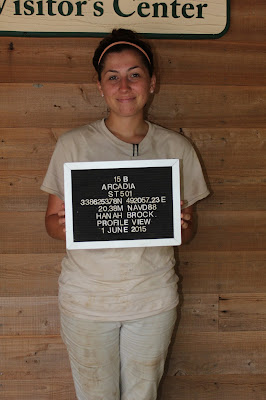
Arcadia Mill Field School: Introducing Hanah Brock

It is my pleasure to introduce Hanah Brock, another undergraduate student with the Arcadia Mill Field School.


"My name is Hanah Brock, and I am a senior at the University of West Florida in the undergraduate archaeology program. I plan to transfer to a masters program next fall and continue my education. My goals for the future include being a biblical  educator focusing on the anthropology of the bible."


Remember that this Friday the field lab will be closed due to the 4th of July holiday weekend. We will return, however, next Friday, July 10 for the Arcadia Mill Public Field Lab between 10AM and 2PM. The lab is free of charge and fully open to the public. However, we do ask that any children under 16 years of age be accompanied by an adult. The last public field lab will be held on July 17, 2015 from 10:00-2:00 as well, so come on down and learn about archaeology and local history! Also, be sure to tune in on Sunday for an update on our fieldwork progress this week!

Monday, June 29, 2015

Week 6 Has Come And Gone!

Time certainly flies! Week six of the field season has come and gone by with a blink of an eye.

We spent a portion of this week ensuring that our paperwork was correct and legible as well as opening several new units! Paperwork and data collection is a crucial step in any successful archaeological project, and through this process, our students learned the importance of clear, concise note taking and paperwork management. But it is not all work all the time. To avoid the rain storms that loomed on Wednesday, we conducted a little lab work and returned downtown for an informational, historical walking tour of downtown Pensacola. If you are interested in taking a tour and learning the colorful history of downtown Pensacola, please visit http://www.historicpensacola.org/visitorinformation.cfm for more information on tour dates, times, and pricing.

Unit 155 was opened adjacent to Unit 153 (pictured below). If you recall, Unit 153 revealed a brick pier and a peculiar, narrow articulated brick wall running east to west. We began excavating Unit 155 with the hope of revealing more of the narrow brick wall. We removed the first level only to find yet ANOTHER brick pier! This pier is a mirror image to the brick pier in the adjacent Unit 153! There is similar brick rubble in the northern portion of the unit and a lighter yellow subsoil to the south of the pier. These brick piers served as structural support for the Simpson House, and we determined that the small wall connecting the two brick piers in Units 153 and 155 is a brick curtain that also enhanced the structural stability of the house.


We continued to make progress on Unit 152. If you recall from previous posts, we uncovered what appears to be another brick pier in the center of Unit 152, pictured below. Progress this week has revealed additional articulated bricks that make it appear larger than other piers in the surrounding units. This may be a different kind of structure or a similar feature that is just better preserved than the others. We won't know for sure until we excavate it further next week.


We also opened a new unit, Unit 156, this week. This unit is adjacent to Unit 154 that contained yet another suspect brick wall feature. We believe this brick wall to be a part of the basement that appeared to be alignment with other articulated brick walls that were discovered during last year's field season. We expected to identify the southwest corner of the basement wall in Unit 156 that should align with wall segments from last year, but what we found caused us to really scratch our heads. The wall in Unit 156 extended to the west, so yet again, we set up another unit to chase that wall, pictured below.


Unit 157 was set to the west of Unit 156 to chase the wall feature and locate its corner. We expected to find a corner of the wall that continued north towards other units from last year, but that is not what we found on Friday. The wall turned to the south! Oral tradition states that the covered entrance to the basement leading to the kitchen, extended slightly beyond the Simpson house. It is possible that we have located the covered entrance area since the brick wall feature and corner extend beyond the west limits of the previously identified basement wall. With looming rain showers, we decided to pack up, contemplate this curiosity over the weekend, and revisit the unit on Monday! (Unfortunately, we did not capture a photo of the corner of the wall for this blog, but we will post one next week. Stay tuned!) Below is an in progress photo of Unit 157 East Half, before we found the corner of the wall heading southward.


This week, we returned to the private property adjacent to the Simpson House lot to continue work on Unit 150. This unit has proven to be a grab bag of interesting cultural remains. Pictured below in Unit 150 is a dark gray burned layer in the north east corner that contains mostly oyster shell. A large iron deposit was also uncovered in association with the burned oyster and midden deposit.


Within this iron deposit, we recovered some interesting tin cans that are very rusty from being exposed to the oxygen and moisture in the soil for so long. They were so fragile that just handling them caused them to flake and break apart. We immediately sent them to our conservation lab on UWF campus. 


Due to the holiday weekend, we will not be holding a field lab this Friday. We will, however, be in the field Monday through Thursday for anyone interested in taking a tour of the Simpson Lot.