
Thursday, June 18, 2015

Wednesday, June 17, 2015
Arcadia Mill Field School Week 4
Week 4 of the Arcadia Field School brought a lot of rainy days for us. Students worked diligently in the field through the limited dry hours of each day, but when the rain picked up, we retreated to the lab to complete paperwork and rough sort artifacts to make the most of our time. We still have our fair share of fun in the lab despite the looming rain clouds.

Our progress this week was focused on three units that we opened last week. If you recall from last week, shovel test 502 was expanded to the 1 meter by 1 meter Unit 153 to reveal more information on the structural brick pier such as orientation, depth, and integrity of the structure. By close of business on Friday, we still have yet to reach the deepest extent of the structure. This is actually good news because this brick pier appears to be mostly intact. We expect that early next week we will reach the bottom of the brick pier, close this unit, and start another unit elsewhere. Below is a photograph of Unit 153 and students Hannah and Robert mapping the unit and features.


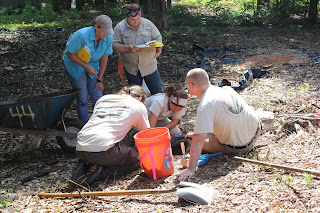
Unit 154 was opened last week as an extension of last year's Unit 138 that contained what we believed to be a brick wall. But the brick structure in Unit 138 is in alignment with the brick piers in Units 152 and 153. After reinterpreting Unit 138, we are investigating Unit 154 for the potential of the wall to be another structural brick pier. We have uncovered portions of mortar in the floor of the unit that is associated with the brick structure. We are so close to revealing the structure, but it will have to wait until next week. We did, however, encounter a fairly sizable root in the western portion of the unit that is too large to remove and yet difficult to work around. Below is a photograph of the unit and one of our students, Beth, removing sediment from the unit to be screened for artifacts.


And Unit 150 was opened in week two of field school. This week, students uncovered a peculiar round soil stain on the floor of the unit. We are unsure of what it is, but it is speculated to be a post that was driven into the ground. So far, no other stains were found, but there was a nice cut nail recovered from the unit. Below is a photo depicting the dark stain in the floor of the unit labeled F503.

We did not make it to the field on the rainy Thursday. Instead, we took the students to visit the FPAN museum, the TT Wentworth Jr. Florida State Museum, and visited the First City Art Center. Below, our students enjoy the museums and pose with the shipwrecked Tristan De Luna.


We want to give a special thank you to the First City Art Center for hosting both Arcadia and Molino Field Schools on Thursday, especially on such short notice! Both field schools were called off for the day due to severe rain storms, and First City Art Center graciously welcomed our very large group to a glass making history discussion and glass blowing demonstration. Each student was invited to observe the process as well as participate in crafting a free blown glass ornament of color choice.


Above, you can see our students working through the various steps in creating their very own glass blown ornament. The delightful experience certainly was the highlight for us all and inspired us to look forward to the other options that First City Art Center has to offer such as glass bead making and ceramic lessons for future rainy days.
If you are interested in the classes, workshops, or studio space that the First City Art Center has to offer, please contact them at 850-429-1222 or visit their website at http://www.firstcityart.org for more information. You can also visit the studio located at 1060 N Guillemard Street, Pensacola, FL 32501.
Don't forget to join us at the Arcadia Mill Public Field Lab every Friday between 10AM and 2PM to learn more about our local history, archaeology, and artifacts. The lab is free of charge and fully open to the public. However, we do ask that any children under 16 be accompanied by an adult. We hope to see you there, and tune in next week for an update on our fieldwork progress!
Friday, June 12, 2015
Arcadia Mill Public Field Lab
Interested in local history? Care to learn more about artifacts and archaeology? Then join us at the Arcadia Mill Public Field Lab TODAY! between 10 AM and 2 PM! The lab is free of charge and fully open to the public. However, we do ask that any children under 16 be accompanied by an adult. We hope to see you there, and tune in tomorrow for an update on our fieldwork progress this week!

Sunday, June 7, 2015
The 3rd Week of Field School Already!!
Time flies when you're having fun and working hard! This week was intense! We saw huge thunderstorms this week and uncovered more structural remains of the Simpson House!

If you remember from last week, in shovel test 501, we began uncovering a possible brick pier on the south side of the Simpson House. This week, we began shovel test 502 over another possible brick pier and we expanded shovel test 501 to a full 1 meter by 1 meter excavation test unit in order to confirm this feature was a pier, and to more fully expose the structural feature for more documentation. Later in the week, we also expanded shovel test 502 to a full 1 meter by 1 meter excavation unit because they also had brick pier! In this new unit 153, they found two intact small jars!
 Meanwhile, we opened an extension of last year's unit 138 after reinterpreting a structural brick feature, which is likely to be another pier that lines up with the rest of the piers on the south side of the Simpson House! Stay tuned next week to see what this extension yields!


Tuesday we had our friend Tristan, from the Florida Public Archaeology Network (FPAN), in the field helping us with our systematic metal detecting survey! We set up the same grid we had been using for our remote sensing survey. Here are our students, Robert Love and Hanah Brock using the metal detecting equipment and marking positive spots with orange pin flags. What we learned is that there are many metal objects in the area!
On Friday, we returned to the adjacent private property, since the utility companies have been so diligent in marking their utility lines and we could safely be certain that our anomalies were not utilities. Previously, we began unit 150 to ground-truth a large anomaly that showed up during the remote sensing work we did during the first two weeks of field school. While we have not uncovered the source of the anomaly just yet, we found many unexpected artifacts in our screens for level 2. These artifacts consisted of numerous charred peach pits, cut iron nails, and small fragments of brick and mortar. This is good evidence that we may have the location of a domestic structure or other outbuilding that will tell us more about life at Arcadia.
Our newest student, Beth Chance, a graduate student from the University of Central Florida, joined us Thursday! We are glad to have her for the rest of the summer! Stay tuned!

If you remember from last week, in shovel test 501, we began uncovering a possible brick pier on the south side of the Simpson House. This week, we began shovel test 502 over another possible brick pier and we expanded shovel test 501 to a full 1 meter by 1 meter excavation test unit in order to confirm this feature was a pier, and to more fully expose the structural feature for more documentation. Later in the week, we also expanded shovel test 502 to a full 1 meter by 1 meter excavation unit because they also had brick pier! In this new unit 153, they found two intact small jars!


Tuesday we had our friend Tristan, from the Florida Public Archaeology Network (FPAN), in the field helping us with our systematic metal detecting survey! We set up the same grid we had been using for our remote sensing survey. Here are our students, Robert Love and Hanah Brock using the metal detecting equipment and marking positive spots with orange pin flags. What we learned is that there are many metal objects in the area!
On Friday, we returned to the adjacent private property, since the utility companies have been so diligent in marking their utility lines and we could safely be certain that our anomalies were not utilities. Previously, we began unit 150 to ground-truth a large anomaly that showed up during the remote sensing work we did during the first two weeks of field school. While we have not uncovered the source of the anomaly just yet, we found many unexpected artifacts in our screens for level 2. These artifacts consisted of numerous charred peach pits, cut iron nails, and small fragments of brick and mortar. This is good evidence that we may have the location of a domestic structure or other outbuilding that will tell us more about life at Arcadia.
Our newest student, Beth Chance, a graduate student from the University of Central Florida, joined us Thursday! We are glad to have her for the rest of the summer! Stay tuned!
Friday, June 5, 2015
Arcadia Mill Public Field Lab
Sunday, May 31, 2015
The Second Week of Field School
Here is to another productive week with the Acadia Mill field school. This week, we focused primarily on the private property to the east of the Simpson Lot where historical slave cabins are suspected to exist beneath the surface. While we dodged rain clouds all week, we got the opportunity to open the first unit of the field season to explore a large anomaly identified by the GPR survey last week.
Undergraduate students Hanah Brock and Kenneth Newquist were the lucky students to practice their precise excavation techniques in this unit. The photograph below shows Kenneth shovel popping the soil into a wheel barrel to be screened for artifacts.


Additional GPR survey over the entire private property revealed a buried gas line which promptly halted excavation on the unit. The utility companies were contacted and will mark the location of the lines by Monday so that we may avoid them with additional unit excavations.

In the meantime, we opened another small shovel test on the Simpson Lot on Friday, and as in many archaeological investigations, the most interesting finds are discovered on the last day of the project. The shovel test, measuring 0.5 x 0.5 meters, revealed what is believed to be remains of a brick pier which served as structural support for the Simpson House. The photograph below shows the shovel test that revealed an articulated brick and mortar feature in an "L" shaped configuration.

The small window of the shovel test only provides a limited view of the structure beneath the ground. We plan to expand the area of the shovel test to explore the feature further. We are very eager to revisit this shovel test bright and early Monday morning.
We will host Friday field labs from 10:00 am to 2:00 pm every Friday in the month of June and July 10th and 17th, and as always, we encourage people to visit us in the field! Stay tuned for updates next week!
Undergraduate students Hanah Brock and Kenneth Newquist were the lucky students to practice their precise excavation techniques in this unit. The photograph below shows Kenneth shovel popping the soil into a wheel barrel to be screened for artifacts.

The unit has yielded few artifacts such as a nail, an oyster shell, and carbonized wood, but additional excavation will hopefully reveal more identifiable artifacts and features.

Additional GPR survey over the entire private property revealed a buried gas line which promptly halted excavation on the unit. The utility companies were contacted and will mark the location of the lines by Monday so that we may avoid them with additional unit excavations.

In the meantime, we opened another small shovel test on the Simpson Lot on Friday, and as in many archaeological investigations, the most interesting finds are discovered on the last day of the project. The shovel test, measuring 0.5 x 0.5 meters, revealed what is believed to be remains of a brick pier which served as structural support for the Simpson House. The photograph below shows the shovel test that revealed an articulated brick and mortar feature in an "L" shaped configuration.

The small window of the shovel test only provides a limited view of the structure beneath the ground. We plan to expand the area of the shovel test to explore the feature further. We are very eager to revisit this shovel test bright and early Monday morning.

We will host Friday field labs from 10:00 am to 2:00 pm every Friday in the month of June and July 10th and 17th, and as always, we encourage people to visit us in the field! Stay tuned for updates next week!
Monday, May 25, 2015
First Week of Arcadia Mill's 2015 Field School!
We have returned! It was a beautiful week back at Arcadia for field school!!
In the beginning of the week, we spent time with our Principle Investigator and Arcadia Site Manager, Adrianne Sams, who gave a tour of the previously excavated areas on this expansive archaeological site. She also gave us an overview of the history of Arcadia and talked about the Simpson Family who once owned Arcadia Mill. Katherine Sims, our Field Director, gave us more information about the excavations of the Simpson family home which was started by the previous 2014 field school. Jan Lloyd, the director of the UWF archaeology lab, was kind enough to come out and share her knowledge about the types of artifacts our new students were likely to find in our excavations this summer. In the picture below, Jan is teaching students Robert Love, Robert Cornforth, Hanah Brock, and Ken Newquist the difference between several types of stoneware we find often in Arcadia-era deposits.

A portion of the ten week field school will be spent in attempting to locate the cabins of domestic slaves the Simpson family owned prior to emancipation. Continued research of Arcadia's enslaved population is the primary research goal of Katherine Sims's Master's thesis and it will hopefully contribute additional information to the history of Arcadia Mill. Previous research suggested that there might be archaeological remains of slave cabins to the east of the Big House. Since the land to the east is private property, Katherine obtained permission from fantastic landowners to investigate the possibility that these slave cabins were located in the vicinity. We are using non-invasive remote sensing methods to obtain an idea of where these structures might be before starting small target excavations.
With this knowledge, we got to work! In order to use the various types of remote sensing equipment at our disposal, we first needed to set in a grid using a total station and several on-site datums. The students learned to set up the total station over a known point (datum) and use it to find new points like grid corners. Below, you can see Ken Newquist and Robert Love are setting up the total station over the main permanent datum on-site.


To obtain precise measurements, we use a total station to measure and record distances with accuracy down to the millimeter. The total station shoots a laser to a prism positioned on top of a stadia rod (seen below) which reflects back to the total station. This process allows the total station to record its position in three dimensional space. Dani Mount, one of the supervisors, is holding the stata rod and prism over a datum to finish setting up the station.


In conjunction with the GPR, we are using another type of remote sensing equipment called a gradiometer. The gradiometer, like a metal detector, is useful for finding metallic artifacts. However, it works on a different principle. Rather than just looking for metal, the gradiometer measures the magnetic field in the surrounding area and compares that to areas nearby. This process produces a map that shows where the magnetic fields are aligned in a particular pattern which can signify bricks, sandstone, burned clay deposits or other objects that are different than the surrounding soil. The lovely Jennifer Melcher is carrying the gradiometer over grids 5 and 6.

LAST BUT NOT LEAST: We finished our first shovel test on Friday! Late Thursday afternoon, we chose an arbitrary spot on the Simpson Lot to get an idea of what the stratigraphy looked like in our current area of research. In the first level, we found small brick fragments, a handmade iron washer, hand-molded soda lime glass, iron cut nails and SIX peach pits. Below, you can see a few of the artifacts we found.

Stay tuned for more updates next week!
Subscribe to:
Posts (Atom)